Denied Again? Here’s the Part Nobody Tells You.
If you’ve been denied before, you probably already have a theory about why. Too many late payments. Score too low. Too much debt. Maybe all three. Or maybe something else…
Sometimes It feels like the system looked at you and said no. But to be hoenst, the frustrating part isn’t the denial itself, it’s not knowing which move actually fixes it.
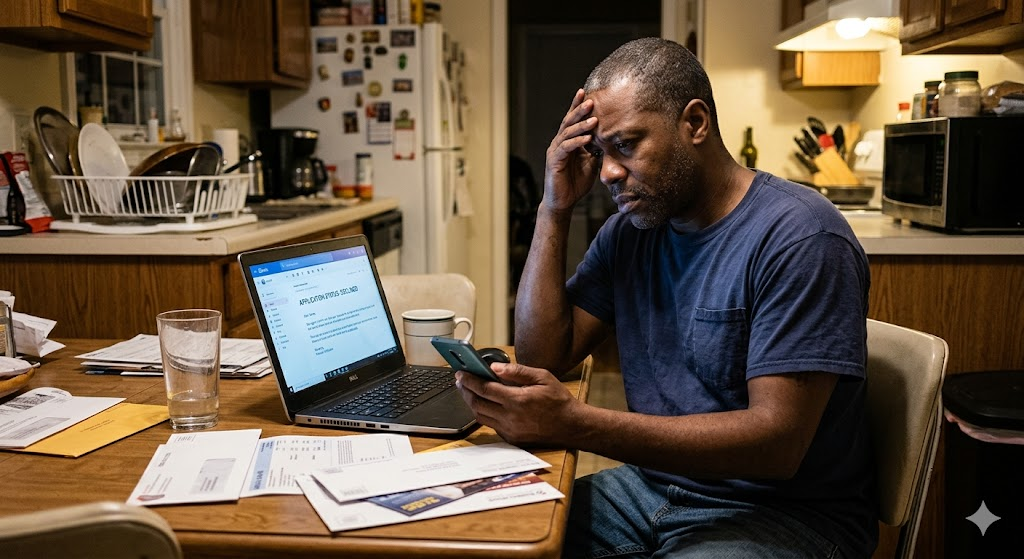
The truth is that you got rejected because you applied for a card that wasn’t built for your situation. That’s it. Not a verdict on your character. Not proof that you’ll never qualify. A mismatch between your current credit profile and a product designed for someone with a different one.
More than half of all credit card applicants in the U.S. have been denied at least once since 2022. You’re not the exception. You’re in the majority and there are real options built specifically for where you are right now.
Why Most People Get Denied (And Why It’s Not What You Think)
Denials almost always come down to one of three things:
- Your score is below the card’s threshold. Most standard credit cards — the ones advertised everywhere — require a score of 660 or higher. If your score is below that, the application gets rejected automatically, regardless of your income or your intentions.
- Too many recent applications. Every time you formally apply for a credit card, the issuer runs a hard inquiry on your credit report. That temporarily lowers your score by a few points. Six or more hard inquiries in a short period signals risk to lenders — and makes the next denial more likely.
- Not enough credit history. If you haven’t had much credit activity, there’s nothing for issuers to evaluate. A thin file can be just as limiting as a negative one.
None of these are permanent. They’re the starting point and each one has a specific path out.
The Step Most People Skip Entirely
After a denial, the fear of another rejection (and another hit to your score) stops most people from trying again.
What most people don’t know is that you don’t have to formally apply to find out if you’ll get approved.
Major issuers like Discover and Capital One offer pre-qualification tools. You enter some basic information, they run a soft check (not a hard inquiry), and you see your approval odds. Your score doesn’t move. Nothing goes on your credit report.
This is the step that changes the equation. You’re not risking another rejection. You’re just getting information before you commit to anything.
What to Look for in a Card When You’ve Been Denied Before
Not all cards are built the same. For someone rebuilding or starting with damaged credit, the right card has a few specific characteristics:
- Low or no annual fee. You shouldn’t be paying just for the privilege of having the card.
- Reports to all three credit bureaus. Equifax, Experian, and TransUnion. If a card only reports to one or two, you’re building a partial record. That slows everything down.
- A clear upgrade path. The best rebuilding cards have a documented path to a better product, higher limit, no deposit, cash back rewards once you’ve established your payment history.
- Accessible approval. Designed for scores in the 500-620 range, not the 700+ range.
A Card Built for This Exact Situation
The Discover it Secured Card is one of the strongest options available for people with limited or damaged credit history.
What makes it different from most secured cards:
No annual fee. Most cards for bad credit charge $39–$99 just to keep the account open. Discover it Secured charges nothing.
It earns cash back. 2% at gas stations and restaurants, 1% on everything else. That’s unusual for a rebuilding card — most offer no rewards at all.
It reports to all three bureaus. Every on-time payment builds your record across Equifax, Experian, and TransUnion simultaneously.
Automatic upgrade review at 7 months. Discover reviews your account after 7 months of on-time payments. If you qualify, they upgrade you to an unsecured card and return your deposit. You don’t have to ask — it happens automatically.
How the deposit works:
The card requires a refundable security deposit of $200 minimum, which becomes your credit limit. That deposit isn’t a fee. It’s your money, held as collateral while you build your history. When you upgrade or close the account in good standing, you get it back.
Who this card is for:
- People with scores between 500 and 620
- Anyone who has been denied for a standard unsecured card
- People who want a rebuilding tool that also earns rewards
- Anyone who can front the $200 deposit
Who should look at other options:
If $200 isn’t available right now, the Self Credit Builder + Secured Visa lets you build the deposit over time through small monthly payments before accessing the card. It takes longer, but it removes the upfront cash barrier entirely.
What Happens After You Get the Card
Getting approved is step one. What you do in the next 12 months is what actually moves the needle.
Two factors control 65% of your credit score:
- Payment history (35% of FICO): Pay your balance on time, every month. Even one missed payment sets the process back significantly.
- Credit utilization (30% of FICO): Keep your balance below 30% of your credit limit. If your limit is $200, try to keep your balance under $60. Below 10% is even better.
People who follow this consistently for 12 months typically see score increases of 50 to 100 points. That improvement opens access to unsecured cards, better loan terms, and lower interest rates across the board.
Now what?
Well, now you have two options:
1. If you’re not quite ready yet maybe you want to understand your situation a little better first, or explore what else is out there. That’s completely fine. There’s no rush, and the right move is always the informed one.
My situation is different Go back and explore other options2. If you’ve read this far and something clicked if you’re ready to stop waiting and take a real step toward changing where you stand financially then this is it. One application. No impact to your score to check. Just a clear answer on whether you qualify.
Check if you pre-qualify for Discover it Secured